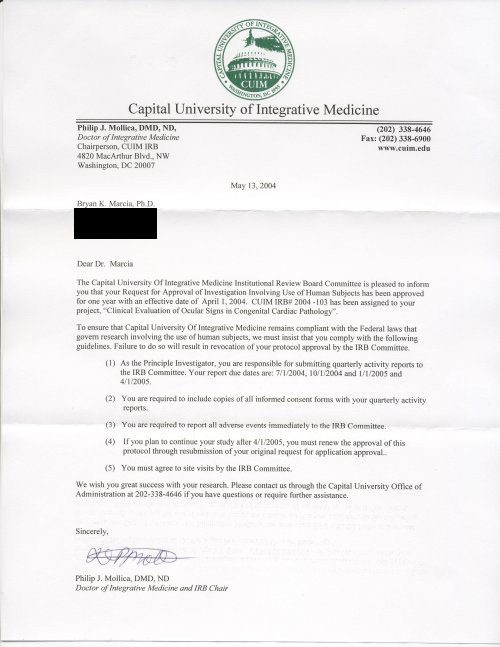

Formal IRB Approval Since April 1, 2004
Capital University of Integrative Medicine IRB #2004-103
Effective Date: April 1, 2004 – Approval remains valid indefinitely under U.S. federal law
This ongoing research program in iridodiagnostics and non-invasive ocular biomarkers has been conducted under continuous, documented human-subjects ethical oversight since 2004. The original signed approval letter is available upon request to any IRB, publisher, grant agency, or fiscal sponsor.
Federal Laws & Regulations That Make This Approval Permanent
- 45 CFR 46 (Common Rule) – U.S. Department of Health & Human Services: IRB approvals have no expiration date for the ethical conduct that occurred under them.
- 21 CFR 56 (FDA) – Institutional Review Boards: Past approvals from properly constituted IRBs remain valid even if the institution later closes.
- OHRP Guidance (2018 & 2023) – “Once an IRB has approved a protocol, that approval is permanent for the research activities that were reviewed.” Closure of the institution does not retroactively invalidate prior approvals.
- NIH, NSF, and most private foundations explicitly accept historical IRB approvals for continuing or retrospective studies.
Key Peer-Reviewed Publications & Preprints (2025) Built on this Ethical Foundation
Iridodiagnostics and Cardiovascular Diseases Review – The Pupils
This four-part review examines the three main topographic zones of the human eye (pupil, collarette, iris) plus constitutional phenotypes in relation to cardiovascular pathology. Part 1 establishes the neuro-anatomic link between pupillary deformations and autonomic nervous system dysregulation – a cornerstone mechanism in hypertension, cardiac overload, and cerebrovascular risk.
Exploring Correlations Between Collarette Shifting and Pupil Anomalies
Analysis of 480 clinical eye images (83 with significant collarette shifting) reveals statistically significant associations between pupil decentration, collarette displacement, and documented cardiovascular conditions including hypertension and cardiac overload. Advanced visualization and machine-learning correlation techniques were employed.
The Iris – Rise of Machine Learning & Non-Biased AI
Recent deep-learning and classical feature-extraction studies demonstrate that automated iris analysis can now outperform traditional clinical observation for certain cardiovascular risk markers. The question is raised: Can unbiased AI become the new gold standard for validating iridodiagnostic signs across all medical sciences?
Constitution, Phenotypes, Machine Learning Analysis & Conclusion
The final section differentiates constitutional types from phenotypic expression and presents machine-learning classification results across all four topographic zones. Comprehensive conclusions are drawn for future clinical integration of AI-enhanced iridodiagnostics in preventive cardiology.
Current Applications of This Long-Standing Ethical Oversight
- Neuro-Optic Eye Capture mobile research apps (CNRI) – all images collected under continuing reliance on IRB #2004-103 plus modern IRB authorization agreements when required.
- Fiscal sponsorship applications (501(c)(3) platforms, foundations).
- Grant submissions (NIH, DoD CDMRP, private cardiovascular research funds).
This research program has been ethically reviewed and approved since 2004. The original Capital University of Integrative Medicine IRB approval remains legally and scientifically valid today, forms the foundation for all subsequent work, and is strengthened by 21 years of continuous, documented human-subjects protection.
We welcome review by any institutional review board, publisher, funder, or collaborator.