
Abstract
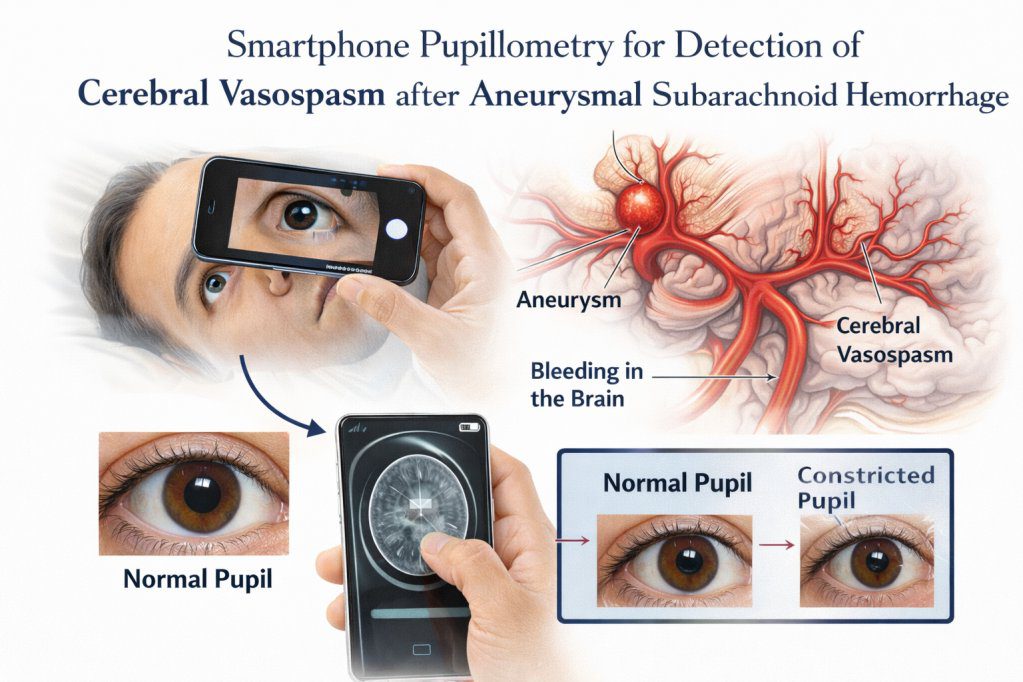
Objectives: Vasospasm is a complication of aneurysmal subarachnoid hemorrhage (aSAH) that can change the trajectory of recovery and is associated with morbidity and mortality. Earlier detection of vasospasm could improve patient outcomes. Our objective is to evaluate the accuracy of smartphone-based quantitative pupillometry in the detection of radiographic vasospasm and delayed cerebral ischemia (DCI) after aSAH.
Results: 49 subjects with aSAH underwent 323 total PLR recordings. For PLR recordings taken with (n=35) and without (n=241) radiographic vasospasm, significant differences were observed in MIN (35.0 ± 7.5 pixels with vasospasm versus 31.6 ± 6.2 pixels without; p=0.002). For PLR recordings taken with (n=43) and without (n=241) DCI, significant differences were observed in MAX (48.9 ± 14.3 pixels with DCI versus 42.5 ± 9.2 pixels without; p<0.001).
Conclusions: Quantitative smartphone pupillometry has the potential to be used to detect radiographic vasospasm and DCI after aSAH.
Authors: Anthony J Maxin 1 , Sophie Kush 2 , Bernice G Gulek 3 , Graham M Winston 4 , John Chae 5 , Rami Shaibani 6 , Lynn B McGrath 7 , Isaac J Abecassis 8 , Michael R Levitt 9
PMID: 39128501 DOI: 10.1016/j.jstrokecerebrovasdis.2024.107922
Abstract link: https://pubmed.ncbi.nlm.nih.gov/39128501/