
Abstract
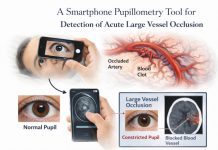
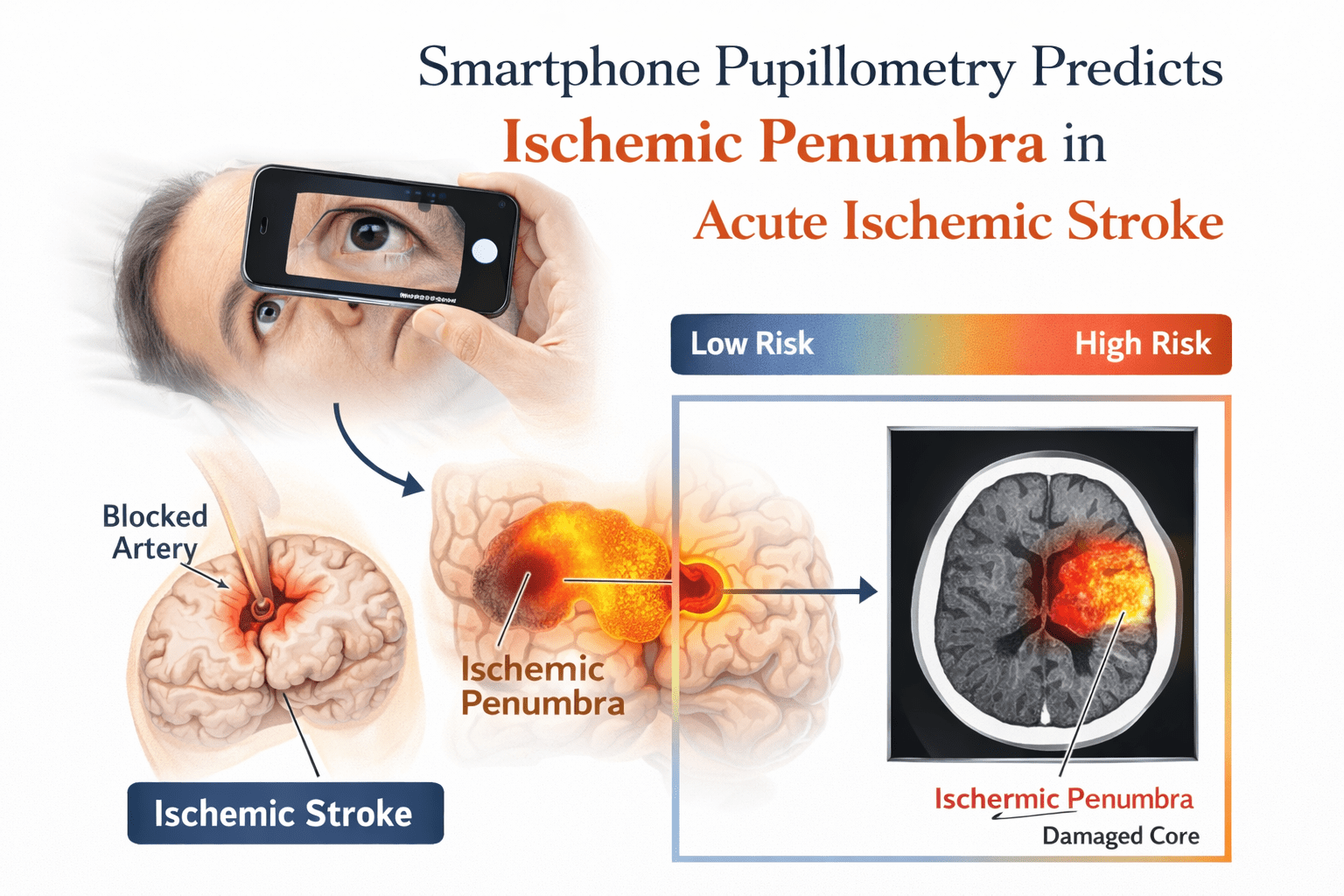
Background: Recent advances in time-sensitive treatment methods for large vessel occlusion (LVO), including medical and mechanical thrombectomy, have increased the importance of rapid recognition of acute ischemic stroke. The pupillary light reflex (PLR) is a biomarker for neurological status. We studied a portable smartphone-based quantitative pupillometry application that has been developed to quantify PLR metrics without requiring external hardware or extensive training to operate. We hypothesized that the PLR curve morphological metrics produced by the smartphone pupillometer could be used to predict the National Institutes of Health Stroke Scale (NIHSS) and CT Perfusion (CTP) core to penumbra volume ratio.
Results: Twenty-two patients with acute ischemic stroke from LVO were recruited, of whom 59 % were female and 21/22 (96 %) had anterior circulation occlusion. The median (± standard deviation) NIHSS was 20.5 ± 9, median ASPECTS was 9 ± 2, and mean CTP core to penumbra volume ratio was 1.02 ± 1.71. Before post-hoc Bonferroni correction, a significant negative correlation was seen between MAX (r = -0.49, p = 0.04), CHANGE (r = -0.74, p < 0.001), and MCV (r = -0.5, p = 0.04) and the core infarct to penumbra volume ratio on CTP. In addition, before post-hoc Bonferroni correction, a significant negative correlation was seen between CHANGE (r = -0.43, p = 0.04) and MCV (r = -0.58, p = 0.005), and the NIHSS. A significant negative correlation between the core infarct to penumbra volume ratio on CTP for CHANGE (p < 0.001) was observed after post-hoc Bonferroni correction.
Conclusions: Quantitative smartphone pupillometry metrics may predict cerebral ischemia and ischemic penumbra in acute ischemic stroke patients with large vessel occlusion prior to intervention.
Authors: Anthony J Maxin 1 , Bernice G Gulek 2 , Hunter Litz 3 , Zachary Brandt 4 , Graham M Winston 5 , Lynn B McGrath 6 , Isaac Joshua Abecassis 7 , Michael R Levitt 8
PMID: 39561861 DOI: 10.1016/j.jstrokecerebrovasdis.2024.108143
Abstract link: https://pubmed.ncbi.nlm.nih.gov/39561861/