

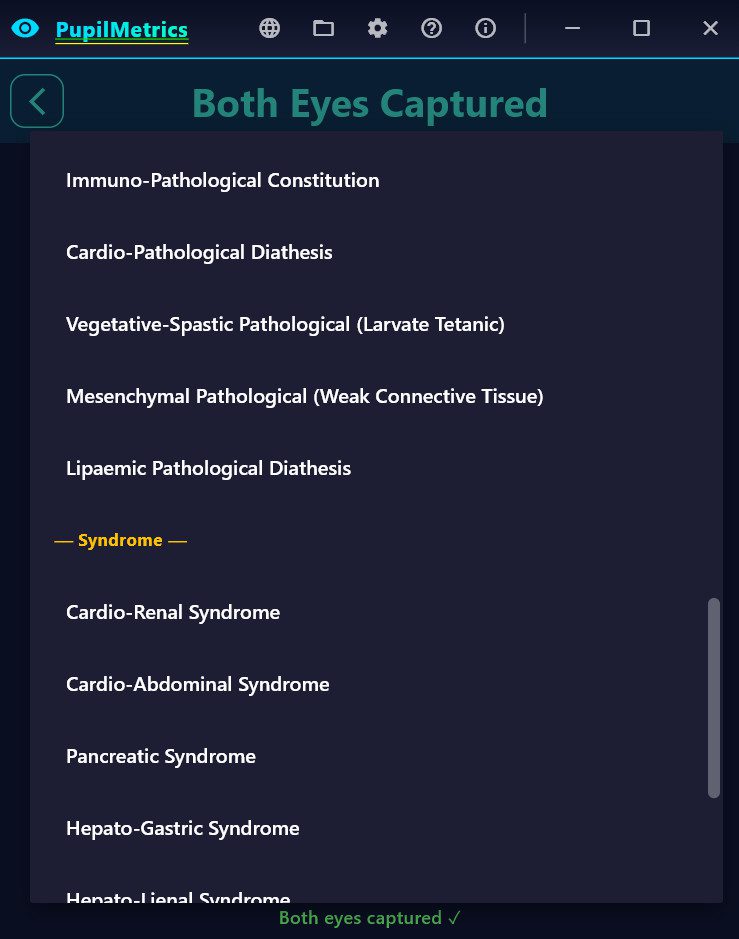
PupilMetrics includes 34 constitutional types organized into six groups:
#### Group 1 — Lymphatic (8 types)
The Lymphatic constitution is the most common in light-eyed populations. The base iris is typically light blue-grey with well-defined, silk-like or wavy fibers. Subtypes are defined by the presence and character of tophi (whitish connective-tissue deposits), pigmentation, and fiber arrangement.
| Type | Key Feature | Primary Tendencies |
|——|————-|——————-|
| **Pure Lymphatic** | Sparse pigment, distinct radial fibers | Lymphatic congestion, allergies, upper-respiratory catarrh, rheumatic tendency |
| **Neurogenic Sensitive** *(Neurolymphatic)* | Thin, tight, “combed-hair” fibers | CNS sensitivity, migraines, autonomic dysfunction, nervous hypersensitivity |
| **Neurogenic Robust** | Thick radials on two levels, transversals | Good nerve vitality but serous membrane susceptibility; overstrain leads to nervous exhaustion |
| **Lymphatic-Hypoplastic** | Thickened collarette, crypts, cloudy pupillary zone | Impaired digestion/assimilation, gastric insufficiency, lowered resistance |
| **Hydrogenoid-Hydrogenic** | Rounded, well-defined white-to-off-white tophi | Strong allergic/exudative tendency, asthma, eczema, weather-related rheumatism |
| **Hydrogenoid-Rheumatic** | Tophi with string-like connections to lymph region | More pronounced rheumatic tendency than base Hydrogenic; dysbiosis |
| **Classic Rheumatic** | Transparent tophi and wisps; scurf rim | Exudative diathesis, streptococcal rheumatic group, joint pain, chronic allergies |
| **Rheumatic-Uric Acidic** | Enhanced plaques and wisps in stroma | Uric acid diathesis; urate stone tendency; liver/kidney uric acid metabolism disorder |
#### Group 2 — Haematogenic (2 types)
The Haematogenic constitution is defined by a uniformly dark brown iris with velvet-like texture and heavy pigmentation. It is associated with blood and metabolic disorders.
| Type | Key Feature | Primary Tendencies |
|——|————-|——————-|
| **Haematogenic I** | Dense velvet-brown iris, sanded-wood light patches | Blood composition dyscrasia; metabolic disorders of liver and pancreas |
| **Haematogenic II** | Brown scleral pigmentation; endocrine signs | Arteriosclerosis, gallstones, hemorrhoids, phlebitis, thyroid and endocrine disorders |
#### Group 3 — Biliary / Mixed (9 types)
The Biliary/Mixed iris shows dispersed brown pigmentation overlying a lighter stroma — producing a light brown appearance with blue-green undertones. The liver, gallbladder, and biliary tract are the primary organ affiliations.
| Type | Key Feature | Primary Tendencies |
|——|————-|——————-|
| **Classic Biliary** *(Mixed Iris)* | Light brown iris; dense nutritive zone pigment | Liver/gallbladder congestion; digestive errors; constipation, flatulence, blood sugar instability |
| **Ferrum Chromotosis** | Golden-brown/red-brown pigments encircling collarette | Hepatic parenchyma damage; fat metabolism difficulty; fatigue; depression |
| **Rheumatic-Uric Acidic-Dyscratic Gr.1** | Central heterochromia; plaques/tophi; cramp rings in liver zone | Rheumatic illness; uric acid metabolism disorder; gastric secretion imbalance |
| **Rheumatic-Uric Acidic-Dyscratic Gr.2** | Strong pigmentation; scurf rim; dispersed liver pigments | Increased chronic inflammatory tendency (sinusitis, appendicitis, tonsillitis) |
| **Rheumatic-Dyscratic-Hepatic** | Distinct tophi/plaque pigmentation; liver-zone darkening | Chronic rheumatism combined with liver dysfunction; dysbiosis |
| **Rheumatic-Uric Acidic-Dyscratic-Hepatic** | Full-iris pigmentation; uric acid clouds; progressed plaques | Chronic rheumatism, uric acid complications, liver and biliary involvement |
| **Rheumatic-Arthrotic** | Mixed iris; brown/yellow tophi pigment; border pigments | Arthrotic chronic rheumatic illness; liver/kidney metabolic irregularity |
| **Rheumatic-Arthrotic-Dyscratic** | Stronger tophi/plaque pigmentation; uric acid granules | Degenerative joint disease; dyspepsia; gastric secretion disorders |
| **Arthrotic-Dyscratic-Dysenzymatic** | Haematogenic transition; rheumatic plaques; stomach-field outline | Liver, pancreas, GI disorders; raised uric acid, blood lipids, blood sugar |
#### Group 4 — Pathological Constitutions (6 types)
Pathological constitutions represent inherited structural weakness patterns identifiable as lacunae, defect markings, or corneal signs, regardless of primary iris color.
| Type | Key Feature | Primary Tendencies |
|——|————-|——————-|
| **Glandular Pathological** | Petal-pattern lacunae around collarette; distended collarette | Endocrine/exocrine glandular weakness; diabetes predisposition; anxiety, depression |
| **Immuno-Pathological** | Grey/black substance-defect points; absent or broken frill | Poor immune resistance; frequent infections; poor physical endurance |
| **Cardio-Pathological** | Open defect marking at 3 o’clock (heart zone) on frill | Inborn left cardiac insufficiency risk; endocarditis/myocarditis susceptibility |
| **Vegetative-Spastic** *(Larvate Tetanic)* | Cramp rings (circular contraction furrows); radial folds | Elevated neuromuscular tension; spasms; migraines; anxiety; hypocalcemia |
| **Mesenchymal Pathological** *(Weak Connective Tissue)* | Large, numerous lacunae; honeycomb patterns; irregular collarette | Inherited connective tissue weakness; varicosities; prolapse; spinal subluxations; fractures |
| **Lipaemic Pathological** | Arcus senilis / cholesterol ring (corneal sign, not iris) | Raised blood lipids; premature arteriosclerosis; stroke risk; liver/fat metabolism disorder |
#### Group 5 — Syndromes (6 types)
Syndromes represent combined constitutional expressions involving specific organ pairings, visible as lacunae patterns in defined iris sectors.
| Type | Key Feature | Primary Tendencies |
|——|————-|——————-|
| **Cardio-Renal** | Lacunae in heart AND kidney fields (left iris); scurf rim | Left cardiac + renal insufficiency; edema; dyspnea; begins in middle age |
| **Cardio-Abdominal** | Large heart lacuna; colonic lacunae; distended collarette in splenic flexure | Colon congestion mechanically stressing heart; flatulence; cardiac dyspnea |
| **Pancreatic** | Lacunae in pancreatic sector and bronchial zone | Multi-glandular insufficiency; hereditary bronchial and pancreatic weakness; childhood infections |
| **Hepato-Gastric** | Liver pigment over liver zone; radial/transverse line from pylorus to liver zone | Liver/gallbladder disturbance; possible erosive ulcer; jaundice tendency |
| **Hepato-Lienal** | Dirty yellow ciliary pigment; dark spleen field (splenic triad) | Spleen enlargement; venous congestion; viral infections; pancreatic excretory dysfunction |
| **Hepato-Renal** | Green-brown-yellow “liver iris”; transversals in liver-kidney zones | Full range of liver and kidney disorders; poor food tolerance; hypotension |
#### Group 6 — Pre-Cancerous Constitutions (3 types)
Pre-cancerous constitutions describe inherited miasmatic terrains associated with chronic toxicosis, metabolic retention, and increased neoplasm risk. These require the greatest caution in clinical interpretation and must never be communicated to a patient without full clinical context.
| Type | Key Feature | Primary Tendencies |
|——|————-|——————-|
| **Psoric** | Loose ciliary zone with crypts; open/closed lacunae near collarette; unequal pupils | Immune system pathology; allergic diseases; skin eruptions; reduced drug tolerance |
| **Sycotic** | Dark pupillary zone; brighter ciliary zone from contraction furrows; scurf rim | Viral/bacterial immune sensitivity; endocrine disturbances; condyloma; arthritis |
| **Carbon Nitrogen** | Dark pupillary crypts; yellow-brown humoral zone; scurf rim; splenic triad | Carbonic/nitrogen waste accumulation; neoplasm tendency from retained toxicosis; arteriosclerosis |